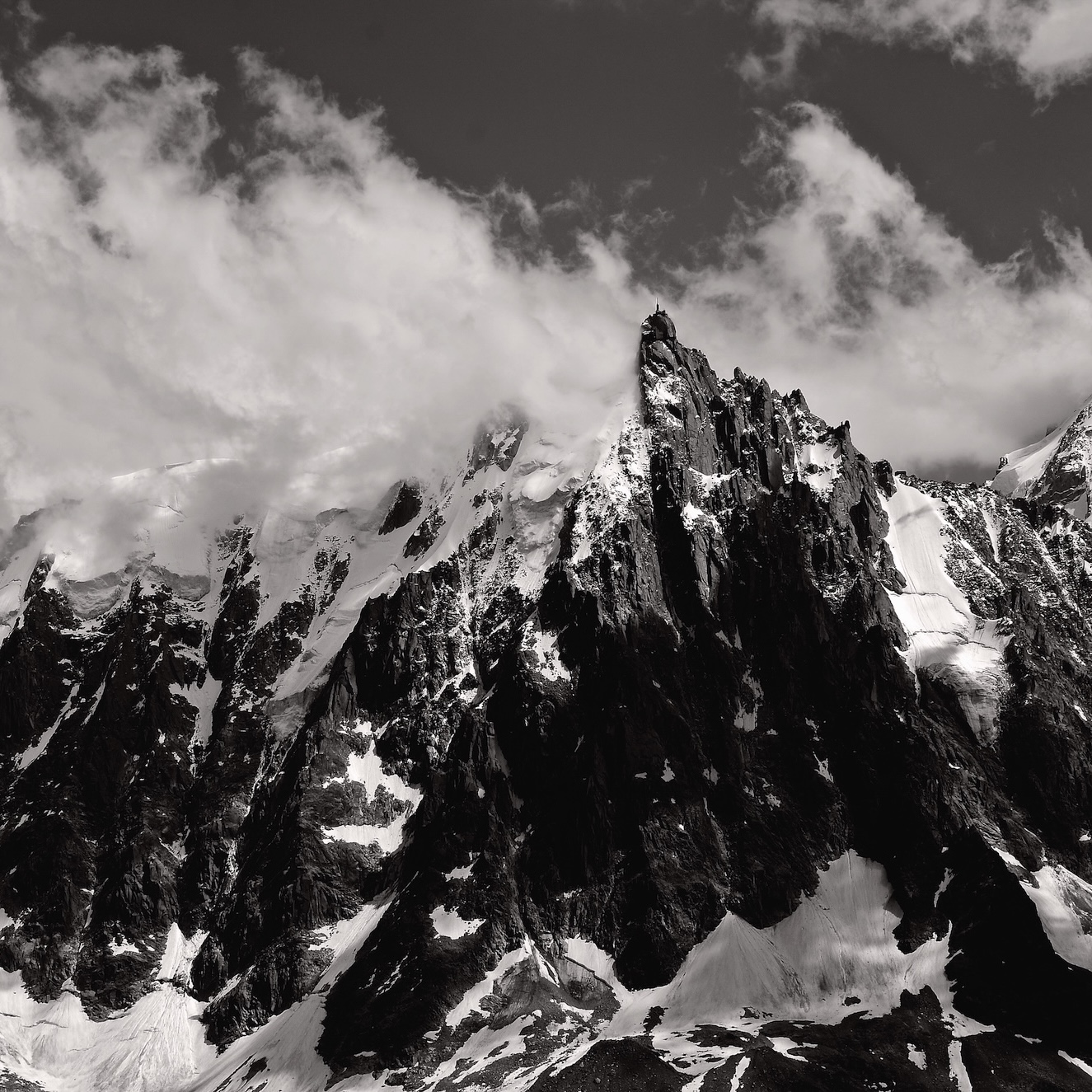
It was in 1910 that the idea of an ‘aerial funicular’ was conceived but it wasn’t until 1924 and the first Winter Olympic Games that it was first used. At the time it ran as far as the 1,685 metres high La Para mid-station. In 1925 the second station opened at Les Glaciers, 2,414 metres, with another station at Col du Midi, 3,600 metres, and a final run to the summit of the Aiguille planned but never completed.
Development continued on and off through both world wars. In World War II the service line to the Col du Midi was used to carry artillery to the summit to stop German forces taking over the Vallée Blanche, but it was never developed into a working station. By this time the lower stations and pylons were in need of repair and a new route via the Plan de l’Aiguille was decided on. In 1951 the new route began construction and the old line renamed the Les Glaciers before it was finally abandoned in 1958, 3 years after the opening of the new Téléphérique de l'Aiguille du Midi.
Today the remnants of the Col du Midi service line have been removed but both the abandoned La Para and Glaciers lift stations remain. It is possible to hike from Chamonix to La Para via La Cascade du Dard.
The new Téléphérique de l'Aiguille du Midi runs from Chamonix Sud to Plan de l’Aiguille, with the second stage running to the summit. For many years it was the highest lift in Europe, recently being overtaken by the Matterhorn Glacier lift in Zermatt, Switzerland but by less than 60 metres. It remains the highest vertical ascent until completion of another lift in Switzerland. An exhibition detailing the construction of the Téléphérique de l'Aiguille du Midi can be found at the Aiguille du Midi summit.
The Trip
The journey begins from Chamonix centre with the queue of alpinists, paragliders, skiers, snowboarders, hikers and tourists. All waiting to be crammed into the cable car to stage one, the Plan d'aiguille. It’s an exciting ride up but even more of a thrill on the way down, with the drops after each pylon inducing the odd murmur from the crowd.
Exiting the cable car, it’s a short walk to the second cable car and another queue to the top. The cable car almost brushes the granite tower on its vertical ascent to the summit. As the doors open the frigid air and lack of oxygen soon becomes apparent - the contrast to the valley floor is stark. A set of steps literally takes your breath away on the way to the top. A series of platforms allow you to look down on the valley or up to Mont Blanc or into Italy and Switzerland.
In summer you can travel to Italy via the Télécabine Panoramic Mont-Blanc and then on to the Skyway Monte Bianco down to Entrèves in Italy’s Aosta valley. The Télécabine Panoramic Mont-Blanc closes in the winter and anytime there is bad weather. You can return by the same method or take a bus via the Mont Blanc tunnel.
Through one of the icy tunnels you can witness the brave souls exiting onto l'arête de l'Aiguille du Midi, heading for a day’s climbing or in winter taking the Vallée Blanche ski run. Even exiting the ice tunnel onto the arête is not to be taken lightly. People are killed every year falling from the descent before their day has even started.
If you want to achieve the highest altitude, take the elevator to the top of the needle or if you have a head for heights, you could try the ‘Step into the Void’, a glass box suspended above a sheer drop to the valley floor.
After that all that is left is a visit to the gift store and join the queue for the ride down.