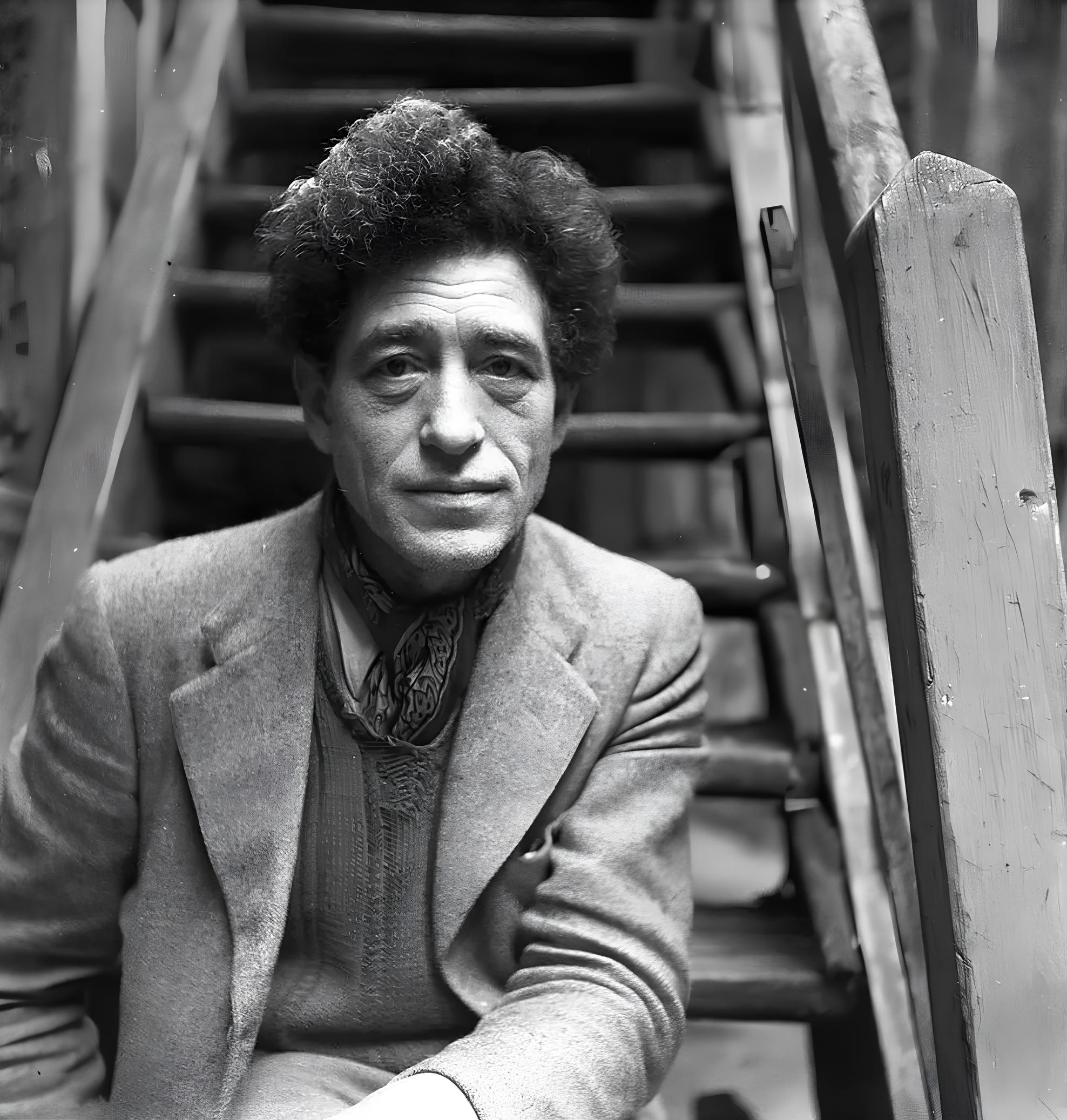
Few artists are as closely associated with Paris as Alberto Giacometti, yet the landscape that shaped his imagination lay hundreds of kilometres away in the Swiss Alps. While the cafés of Montparnasse and the post war art world brought him international recognition, it was the quiet village of Stampa in the Bregaglia Valley that remained his constant point of return.
Born in Stampa in 1901, Giacometti grew up surrounded by towering granite peaks, narrow valleys and dramatic shifts in light. His father, Giovanni Giacometti, was an accomplished painter whose colourful landscapes captured the changing moods of the Engadin and Bregaglia. Creativity was woven into everyday life. Alberto's younger brother Diego would later become his closest collaborator, while cousin Augusto Giacometti established himself as one of Switzerland's leading painters.
Unlike many artists who leave their birthplace behind, Giacometti never truly did. Even after establishing his studio in Paris, he returned to Stampa whenever circumstances allowed. During the Second World War, unable to remain in occupied France, he spent several years back in Switzerland, working in the family's modest atelier beside the house where he had grown up.
The studio was remarkably small. Cramped, unpretentious and largely unchanged throughout his life, it became a place where some of the twentieth century's most celebrated sculptures were conceived. The contrast remains striking today. One of modern art's defining figures worked not in a grand workshop but in a simple stone building beneath the mountains.
Giacometti's sculptures seem far removed from the Alpine landscape. His elongated figures are fragile, solitary and almost weightless, while the mountains surrounding Stampa are vast, solid and immovable. Yet the relationship becomes clearer when standing in the valley itself.
The Bregaglia has an extraordinary sense of scale. Villages appear small against steep rock faces, while individual people seem almost insignificant beneath the peaks. Giacometti's figures possess much the same quality. They stand alone, isolated within space, inviting the viewer to consider the relationship between the individual and the world around them.
Giacometti’s work explored what it feels like to encounter another person across distance, how memory alters appearance, and how space itself shapes our understanding of form. Those questions were undoubtedly refined in Paris, but they were first asked amongst the mountains of southern Switzerland.
Visitors following Giacometti's story can still explore many of the places that defined his life. The atelier remains preserved beside the family home, while nearby Borgonovo is home to the family cemetery where Alberto, Diego and Giovanni Giacometti are buried beneath a simple memorial stone.
Unlike many places associated with famous artists, Stampa has resisted becoming a monument to its past. The village remains quiet and lived in, its significance hidden rather than announced.
The Alps have inspired explorers, engineers, architects and photographers. In Giacometti's case, they shaped one of the most distinctive artistic voices of the twentieth century. His sculptures may have found homes in the world's greatest museums, but their roots remain firmly planted in a small Alpine village where mountains, light and silence continue much as they always have.