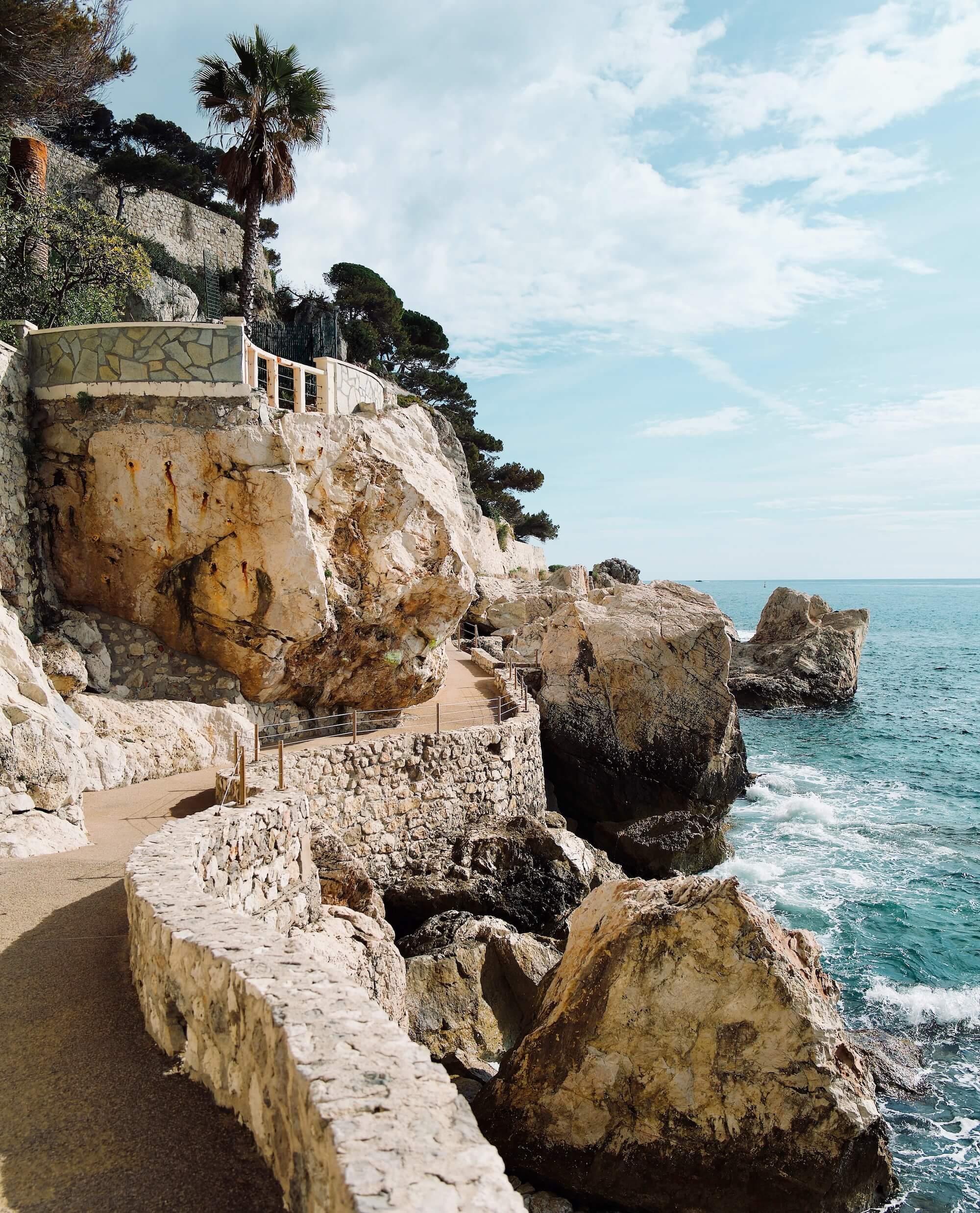
Wedged between the sea and the steep limestone cliffs, Cap d'Ail occupies a remarkable position. The town sits so close to Monaco that the border often feels entirely theoretical. Apartment blocks, marinas and winding roads spill seamlessly from one municipality to the next, while much of the local population crosses into the principality each day for work.
The reality of life on this stretch of coast is best experienced on the Basse Corniche. The lowest of the Riviera's three famous corniche roads, it funnels commuters, delivery vans, buses, cyclists and scooters through an impossibly narrow corridor between sea and mountain. Traffic can feel almost theatrical. We've watched scooter riders carrying dogs on their laps, pelotons threading between stationary vehicles, and buses squeezing through gaps that appear several centimetres too small. The folding wing mirrors earn their keep here.
Despite its modest size, Cap d'Ail rewards exploration. Two beaches, a small harbour and a series of rocky coves are linked by one of the Riviera's finest coastal walks. The town's name is thought to derive from an Italian phrase meaning 'Bee Cape', a reference to the beekeepers who once worked these slopes when the area lay under Italian administration. Their legacy survives on the town's coat of arms.
Cap d'Ail also holds an unexpected place in mountain biking history. In 1993, the steep terrain above the town hosted one of the earliest UCI Mountain Bike Downhill World Cup races. Riders launched from high on the hillside below Tête de Chien, tackling a succession of tight switchbacks before plunging towards the Mediterranean and the finish line beside the road. Development and erosion have long since altered the route, but the contrast between elite downhill racing and the luxury Riviera backdrop remains one of the sport's more unusual chapters.
The best way to experience Cap d'Ail today is on foot. The spectacular Chemin des Douaniers, the former customs path that traces the coastline from Nice towards Monaco, passes through the town via Plage Mala. Carved into the rocks above clear turquoise water, it offers a perspective that the traffic-clogged roads never can. The customs officers who once patrolled this route may have had demanding work, but few could have complained about the view.