When we think of watches, it's the metropolitan city of Geneva that comes to mind but many of the most prestigious brands are found in the small village of Le Brassus, an hour away from Geneva in the rolling hills of the Jura.
Le Brassus is home to ateliers of the Audemars Piguet watch brand, where two ambitious locals, Jules Louis Audemars and Edward Auguste Piguet established a workshop in their home village in 1875. Initially, they made use of the local artisans to make the watch movements and send them to Geneva but soon moved to making the watches. Today Audemars Piquet continues to make complicated watches in the valley and is still family-owned. A new building in the villages seeks to bring together all of their workers in one place.
Arriving at Le Brassus brings you almost directly to the Audemars Piquet building, the Hotel des Horologers (owned by AP), and the Musée Atelier, all on the main street. The Musée is an impressive spiral-shaped building that opened in late 2020 and was designed by the Bjarke Ingels Group. Attached to the original Audemars Piguet workshop, the historic building has also been restored and features a welcoming lounge for guests. The Musée is by appointment only, and features tours in French and English a few afternoons a week, booked online, in advance, for 30 Swiss Francs. Arriving outside before your allocated time involves a wait for the door to be opened, and time to marvel at the buildings. Ten minutes before your booking, the door opens and you are welcomed into the family of Audemars Piquet. Identification checked you are seated in a plush lounge with other guests, usually no more than 8, offered drinks and chocolate while engaging with hosts. I’m told it’s similar to the Audemars Piquet houses (larger boutiques) found in some major cities.
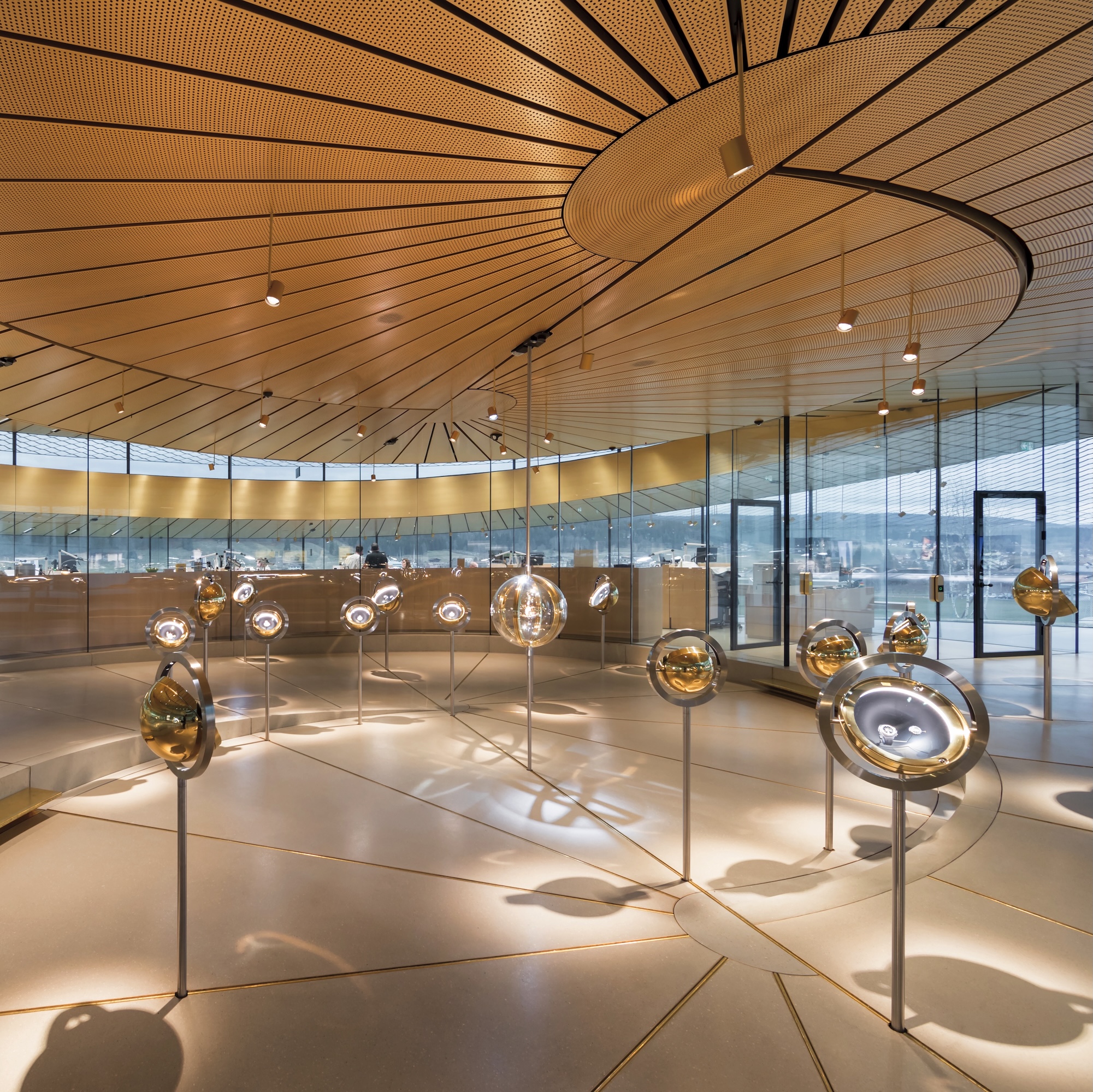
After some introductory information, the tour of the Musée begins with a look at the new building and its load-bearing curved glass walls with a bronze mesh sitting over the top of the glazed facade to filter sunlight without obstructing views of the Jura mountains. The spiral roof windows are also shaded with bronze and grass covers the outside roof of the building to create a lawn in the summer months.
Inside, the curved glass walls converge in a clockwise direction to channel visitors through the building as though they are walking inside the spring of a watch. The details of the building mimic the watches, 300 of which reside in exhibitions.
Unlike most machines and most buildings today that have a disconnect between the body and the mind, the hardware and the software, for the Musée Atelier Audemars Piguet we have attempted to completely integrate the geometry and the performance, the form and the function, the space and the structure, the interior and the exterior in a symbiotic whole. It's an architecture in which the form is inseparable from its content, exposed like the gears and springs in a skeletonised open work. Bjarke Ingels — Founder & Creative Director, BIG
Amongst the displays are interactive models demonstrating the complications and movements of the watches. Particularly amusing is the chronograph model showing the Michael Schumacher lap timer with a moving race car. I won’t spoil it though. If you fancy yourself as a watchmaker, there is a chance to try some of the skills - like picking up one of the small screws and screwing it in. Sounds easy. This isn’t a small screw by watching making standards though. One display allows you to look through a microscope at a screw. Looks just like a normal screw until you attempt to see it without the enlargement - when it appears as no more than a speck of dust.
The Musée also features a look into the actual watchmakers in the Grandes Complications workshop, where a single watch is assembled from 648 pieces over eight months. Then there are the watches. From the pocket watches of the 1800s and 1900s to today’s Royal Oak concepts. At the centre of the building is the original ‘Universelle’ – Audemars Piguet's most complicated watch made in 1899, its movement is composed of 1168 parts and endowed with 21 functions. Of course, the iconic Royal Oak is the most featured of the watches, its history has been told many times. Launched in 1972, its appeal as an expensive steel watch was not guaranteed and the following success has dominated the brand ever since. And there are a lot of models. At the end of the tour, there is a grand reveal of them, in a set of glass cases. Almost impossible to take them all in.
The final exhibition is a temporary room containing what is the watchmaking equivalent of the opening scene of ‘Back to the Future’, a marvel of moving parts and automation driven by a simple mechanism. This display leads to the latest and greatest watch - The Code 11.59 By Audemars Piguet Ultra-Complication Universelle (Rd#4). Harking back to the original, the watch has 40 functions with 23 complications.
The tour is an insight into watchmaking with this remarkable company. There is no hard sell here - there is no need, you can’t buy a watch here (or jump the queue to own one) and Audemars Piguet makes less than 50,000 watches a year with an average price of 27,000 Swiss francs. Rolex by comparison manufactures an estimated one million watches a year. The attention to detail on display at the Musée is in everything from the espresso and chocolate to the building, and not something encountered in everyday life. Rarely do you experience something this elevated.