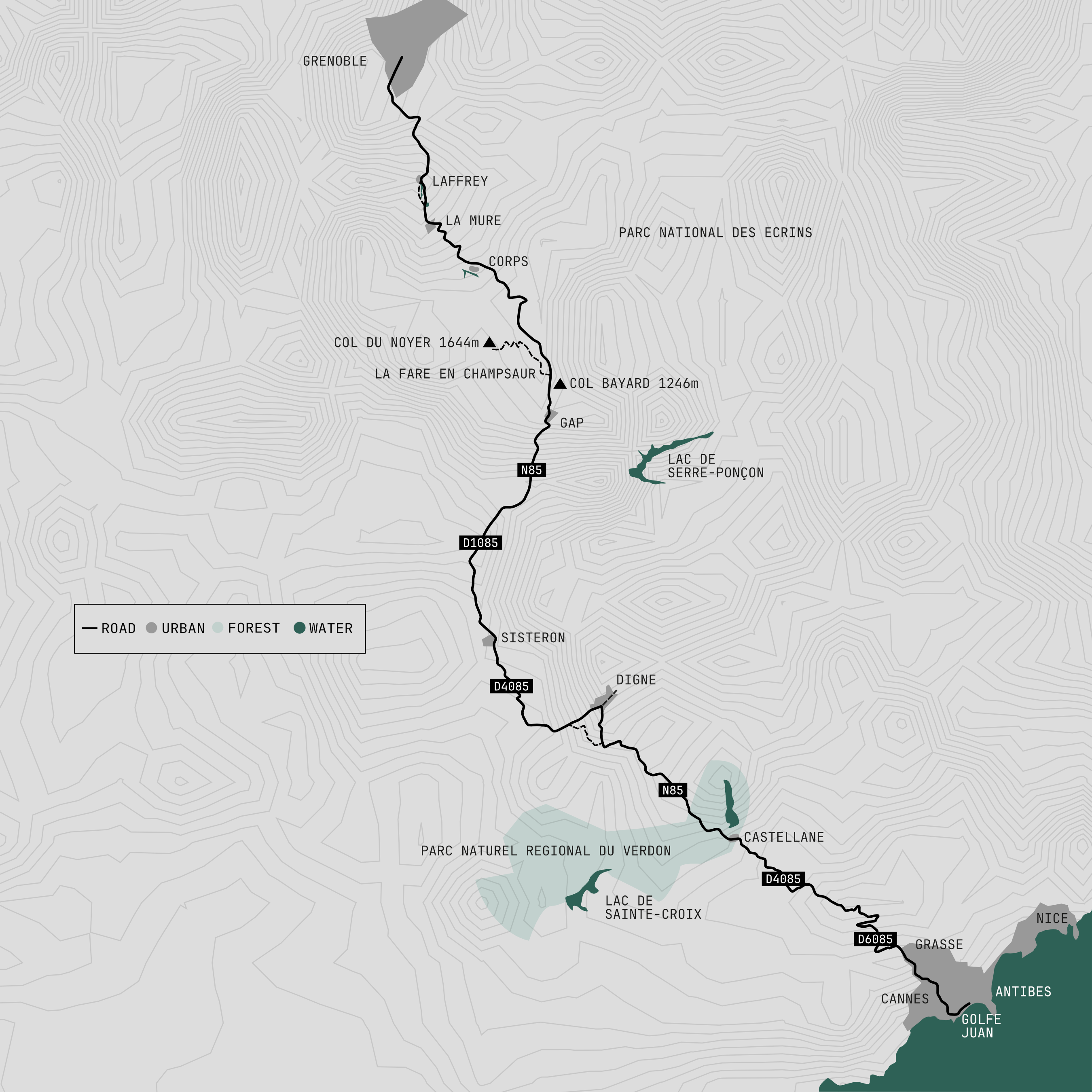
Today, Napoléon’s legendary march north from exile is not just a page in a history book - it’s a journey you can trace on two or four wheels. Known officially since 1932 as the Route Napoléon, the N85 stretches 314 kilometres from Golfe-Juan on the Côte d’Azur to Grenoble in the foothills of the Alps. Once referred to as the Winter Alps Route, this path follows, as closely as modern roads allow, the footsteps of Napoléon and the small army that accompanied him after his escape from Elba.
The route is open year-round, and along the way you’ll find commemorative plaques, monuments, and in some places, statues of the French Imperial Eagle - the iconic standard borne at the head of Napoléon’s columns. Though it diverges from the exact track of the original march due to the demands of modern infrastructure, the RN 85 winds through the same dramatic Alpine landscapes that witnessed one of history’s most audacious political comebacks.
Travelling north from the Mediterranean, the road leads through the departments of Alpes-Maritimes, Alpes-de-Haute-Provence, Hautes-Alpes, and Isère - a sweep of scenery that ranges from glittering sea views to snow-capped peaks. It begins at Golfe-Juan, the beach where Napoléon landed with around a thousand men, and climbs steadily into the mountains.
The route starts from a roundabout on the sea front in Golfe-Juan. Signs on the wall point to the historic nature of this inauspicious starting point. You can follow the side roads through Vallauris, Mougins up to Grasse, or take the main road through Cannes. The road then snakes through Castellane, the narrow passes of the Southern Alps, and the spa town of Digne, before reaching the fortress town of Sisteron and the Alpine city of Gap. The highest point on the journey is Col Bayard at 1,246 metres, a reminder of the physical challenge the army faced as they marched towards destiny.
Driving the Route Napoléon takes around seven hours, but it rewards a slower pace. Split it over two days, and you’ll have time to stop at historic towns, panoramic viewpoints, and markers that quietly but powerfully evoke the drama of the Hundred Days - that brief, breathless episode when Napoléon returned to power without firing a shot.
Though Napoléon’s original march ran south to north, the modern route is compelling in either direction. Whether you’re tracing the emperor’s defiance step by step or simply enjoying one of France’s great scenic drives, the Route Napoléon is a rare blend of natural beauty and living history.