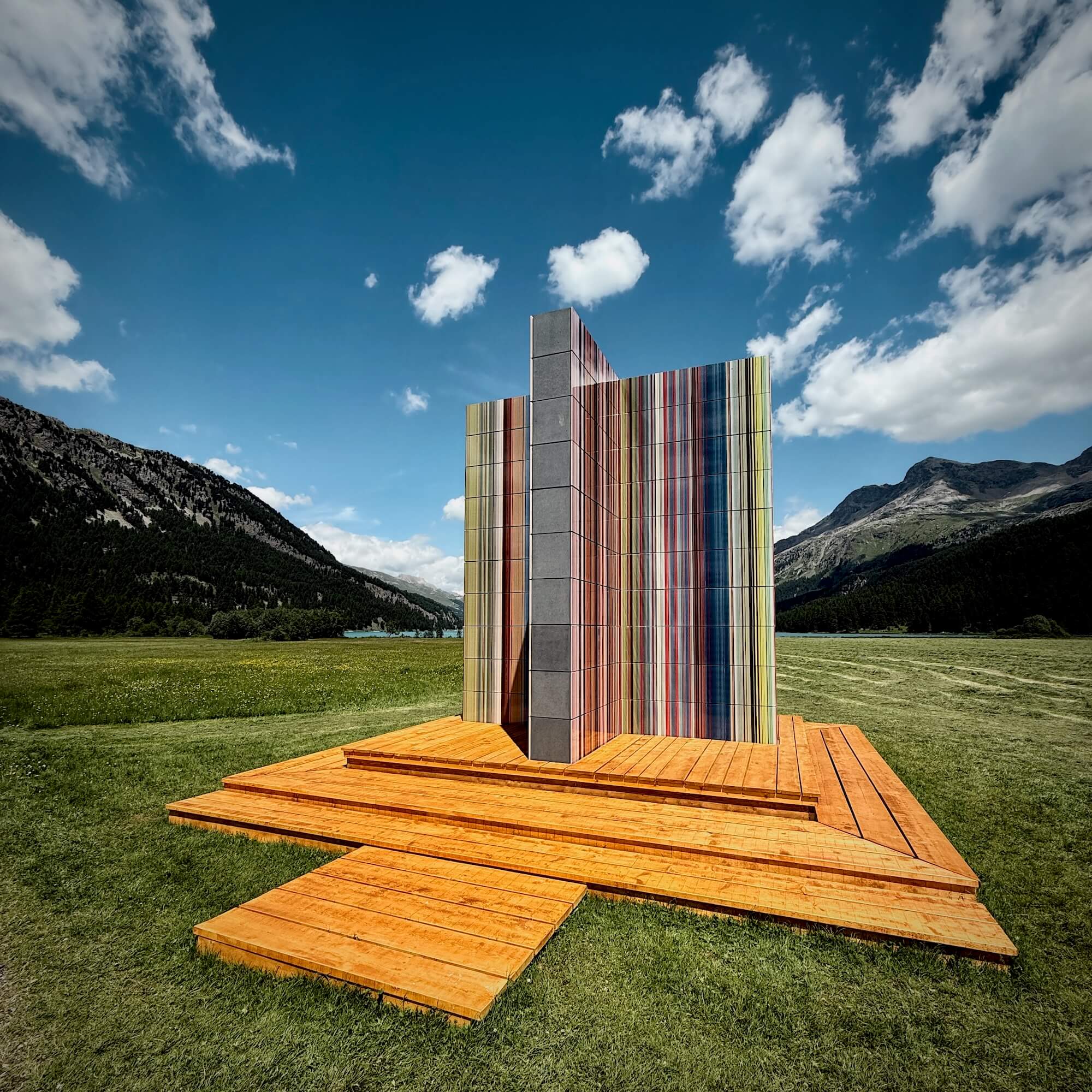
Contemporary art often arrives in a landscape as a visitor. A sculpture is placed in a square, a gallery occupies an old industrial building, and the relationship between artwork and place rarely extends beyond convenience. Gerhard Richter's Strip Tower (962) is more complex. Although the work has travelled between exhibitions and collections, its appearance in the Upper Engadine feels unusually at home among the forests, lakes and mountains that have inspired Richter for decades.
The tower is more than five metres high, its ceramic surfaces shimmer with hundreds of coloured stripes, while eight interlocking panels form a cross-shaped interior that visitors can walk through. It has no obvious front or back. Instead, it changes as you move around it, reflecting light and drawing the surrounding landscape into its surface.
Richter is one of the most important artists of the past sixty years, although he has rarely been associated with any single movement or style. Born in Dresden in 1932, his work ranges from blurred photorealist paintings and landscapes to monumental abstractions created by dragging large squeegees across layers of wet paint. Photography, memory and chance all play central roles in his practice.
Strip Tower (962) began not as a sculpture but as one of those abstract paintings. Richter took Abstract Painting 724-4, completed in 1990, photographed it, digitised the image and repeatedly divided it into ever finer strips. The strips were mirrored, stretched and recombined until the original painting disappeared into a sequence of vibrant bands of colour. What began as paint on canvas became digital information before finally returning to the physical world as glazed ceramic panels.
It is a process that reflects Richter's lifelong interest in translation, how an image changes as it moves between media, and how perception itself shapes what we see.
Richter's connection to the Engadine adds another layer to the story. Since the late 1980s he has spent time in the region, drawn by the extraordinary clarity of its light and the quiet character of the landscape. Unlike the dramatic Alpine painters of the nineteenth century, he has never sought the spectacle of towering peaks or violent storms. Instead, the appeal lies in atmosphere itself: crystalline air, shifting weather and changing reflections across water, rock and snow.
Walking around the cross-shape reinforces this relationship. The coloured panels surround the visitor while openings frame glimpses of forest, sky and mountain. Rather than competing with the landscape, the sculpture encourages a different way of looking at it.
This dialogue between contemporary art and the Alpine environment explains why Strip Tower (962) has resonated so strongly during its appearances in the Engadine. The work was not created for the mountains, yet the clarity of its colours, its responsiveness to light and its constantly shifting appearance feel entirely at ease among them.
The installation is in place until Spring 2029.