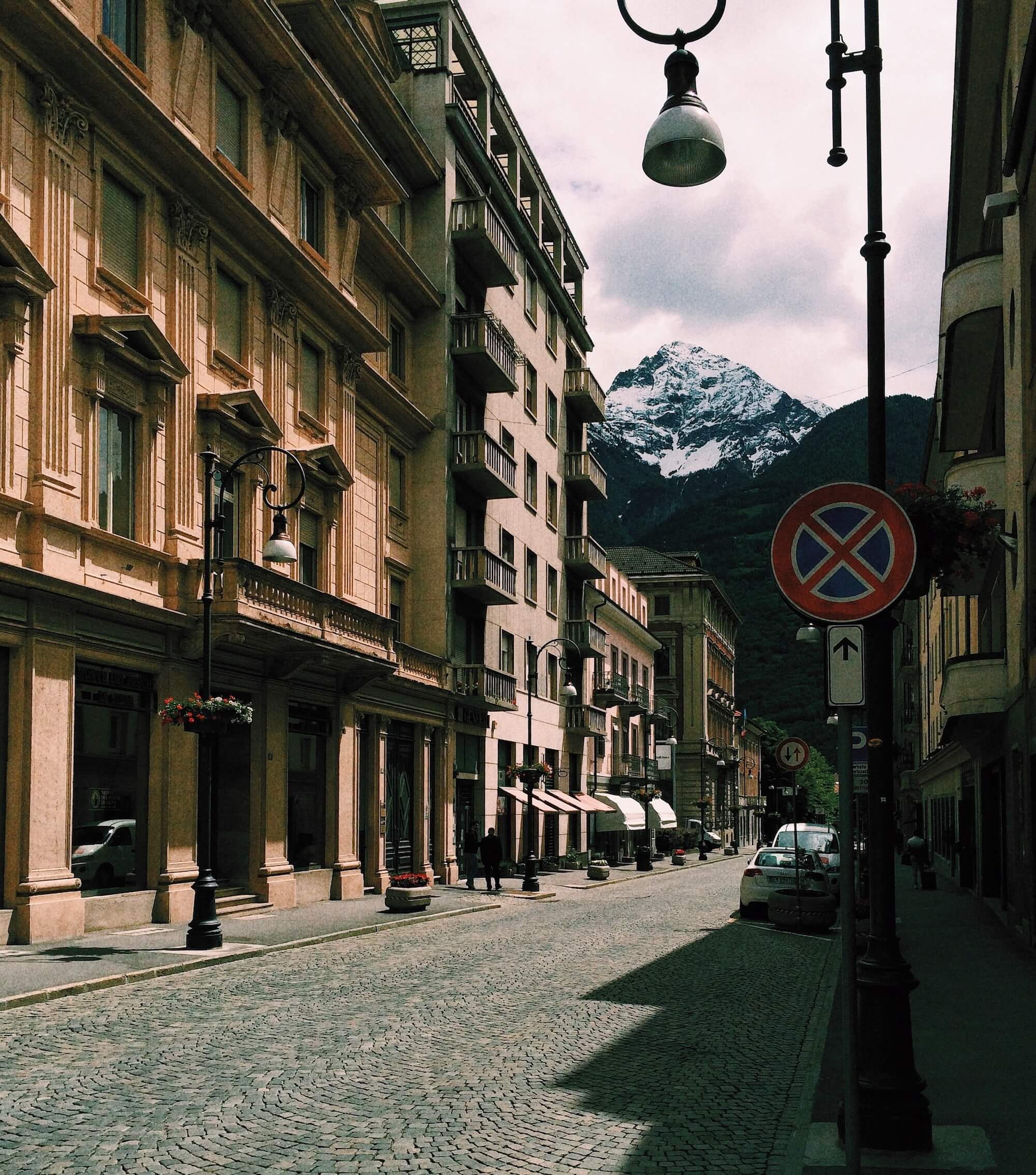
Aosta’s prime position on the border of France and Switzerland gave it considerable strategic importance for the Roman Empire. Situated in a valley at the confluence of both Saint-Bernard passes, this is a classic Italian town based on a Roman plan.
Aosta is the principal city of the Valle d’Aosta, the Valley of Augustus, named after the Roman emperor Caesar Augustus. The Roman town walls of the ancient Augusta Prætoria Salassorum are still preserved almost in their entirety. We enter the town on the main road, which runs roughly east to west and divides the town in two, an arrangement created by the Romans to make guarding the road a priority. The town is a mix of modern and ancient, with the façade of a Roman theatre remaining among more contemporary buildings.
We park in a car park near the centre, although there are many on-street places. Don’t park across the railway tracks from the centre, though, as there are only a couple of places to cross, making the walk to and from the centre in the midday sun unpleasantly long.
We traverse the main pedestrian route, the Via Porta Pretoria. This takes us past most of the scenic spots, including the Porta Pretoria, an impressive Roman gateway that has been sympathetically incorporated into the slightly more modern town centre. The ruins of the Roman theatre can be viewed for a fee, or you can stroll down one of the tiny alleyways and peer at it from there. At the eastern end of the street is the Arch of Augustus, built in about 25 BCE as a tribute to Augustus after his victory over the Gallic Salassi tribe.
At this point, the smell of espresso draws us back towards the central Piazza Émile Chanoux, which is home to the town hall, as well as many cafes and shops, and on a direct route to and from the town’s ruins. It’s a great place to stop and enjoy the views, the architecture and the smartly dressed denizens of Aosta. It’s interesting that less than 50 kilometres from Chamonix and its streets of outdoor-equipped, down-jacketed Chamoniards, the Aostani are in fashionable outfits and even the odd suit.