When you arrive in the Chamonix valley from the autoroute from Geneva, the transition is surprising. The autoroute rises from the Arve Valley onto piers that peak at the Égratz viaduct. The road twists and turns as the valley narrows, and you drive through a series of tunnels that eventually open out into a granite landscape, topped with snow. To the south-east, the Mont Blanc range rises so steeply that in the depths of winter it blocks the sunlight from reaching the valley floor until well into the middle of the day. On the opposite side, the red gneiss of the Aiguilles Rouges catches whatever pale light is left. It is an uncompromising topography, one that compresses all human activity into a narrow strip between the mountains.
Mention to anyone that you are visiting Chamonix and the immediate assumption is of athletic intent. You are expected to be carrying ice axes, trail shoes, or wide skis. Yet long before it became an arena for adrenaline seekers, the valley was a destination for contemplation. When two English travellers, William Windham and Richard Pococke, rode into what was then known as "Chamouny" in 1741, they brought no mountaineering ambitions. They were aristocrats on a grand tour, writing literary journals that introduced the valley to European polite society and named the frozen expanse at Montenvers the "Sea of Ice". Decades later, Mary Shelley arrived on horseback, looked at the same glacier, pronounced it "the most desolate place in the world", and promptly used the environment as the setting for the novel, Frankenstein.
Those early visitors were painters, poets, and naturalists. Mountaineering was an accidental outcome of their desire to inspect the landscape. That intellectual, eccentric legacy remains woven into the fabric of the town, even if it is now partially obscured by Gore-Tex and base layers.
Chamonix makes little effort to play to the Instagram-friendly Alpine village image. There are classic timber chalets, mostly large and empty, owned by asset-hoarding millionaires. Instead, the town is a dense, pragmatic archive of its own history. Belle Époque grandeur sits directly alongside mid-century concrete blocks and utilitarian 1970s apartment buildings. The Hotel Richemond, built in 1914, stands near the centre, retained by the same family since its inception, having weathered requisition by the German Wehrmacht during the Second World War. Higher up the valley walls, lavish multi-million-euro chalets overlook modestly framed housing built for the local workforce. It is an urban texture dictated by space constraints and economic surges rather than aesthetic master planning.
The permanent population hovers around 9,000. On a peak summer or winter day, that figure expands to over 100,000, creating an urban density usually reserved for mid-sized cities. This seasonal influx generates a strange hybrid atmosphere: part thrill seeker, part tourist hub. To the south of the town, the heavy freight traffic queuing for the 11.6-kilometre Mont Blanc Tunnel hums continuously, while overhead, paragliders drift quietly across the sky like colourful sails in the blue sky.
The many glaciers here are not static monuments; they’re indicators of a changing climate. Recent measurements confirm that both the Sea of Ice (Mer de Glace) and the Argentière glacier have retreated by roughly 800 metres over the last three decades. On the surrounding peaks, thawing permafrost has increased rockfall, permanently altering classic climbing routes across the range. The mountains feel alive, but fragile, working on a timeline that makes human ambitions appear brief.
Yet the sheer scale of these mountains continues to pull people in. Upwards of 30,000 climbing parties attempt to reach the 4,809-metre summit of Mont Blanc each year, supported by the busy helicopters of Peloton de Gendarmerie de Haute Montagne (PGHM) and Sécurité Civile, maintaining a constant fixture in the sky.
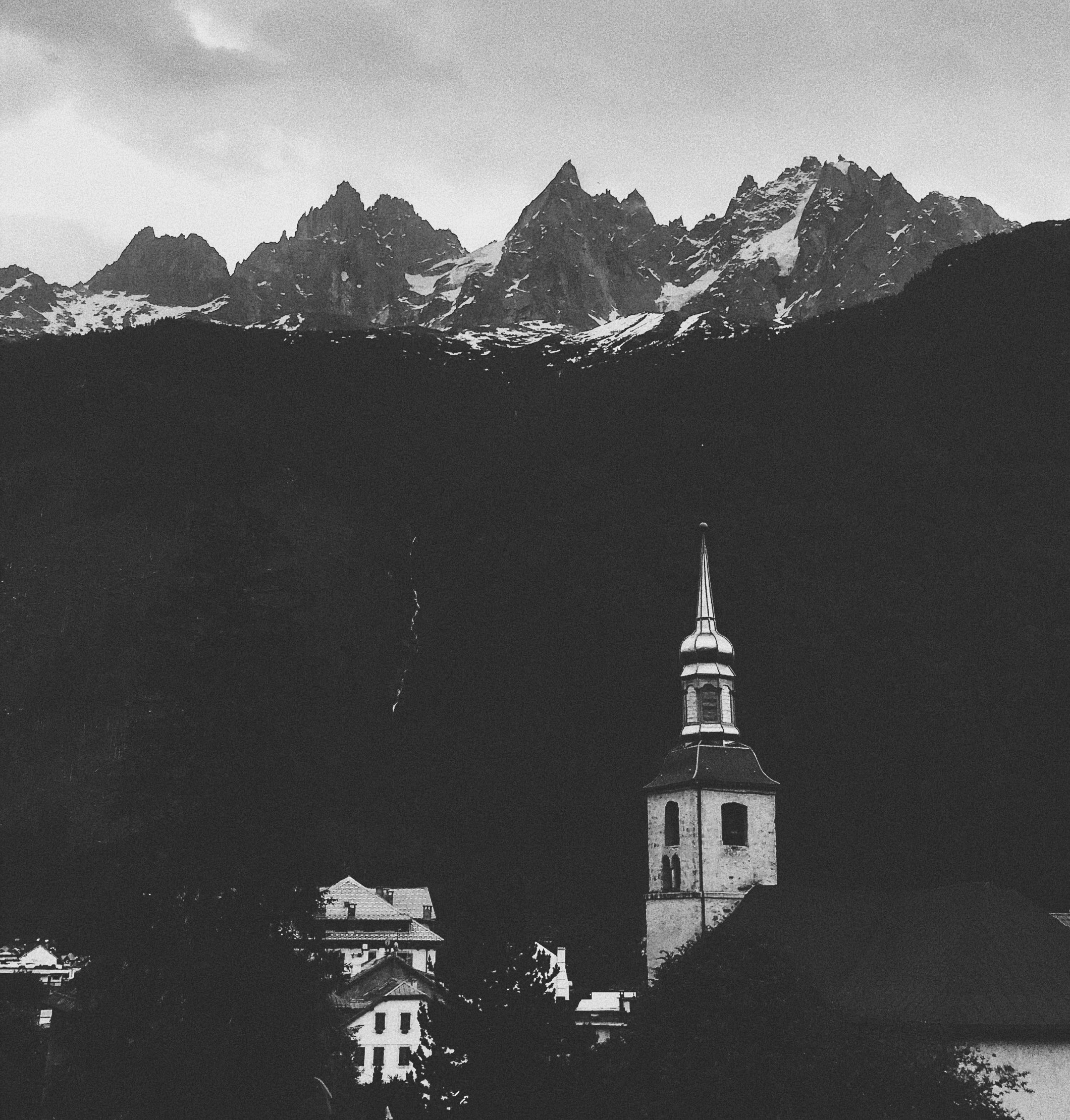
Away from those high places and lift queues, other details reveal the town’s character. In Le Parc Couttet, a small public space hidden near the town centre, massive granite boulders sit scattered across the lawn. They are natural remnants left behind by glaciers that once extended all the way to the valley floor. Nearby, in the Jardins de Fujiyoshida, a small bronze sculpture titled “Warashiko” looks out across the church and Aiguilles beyond. From here, the mountains appear less like an achievement to be earned and more like watchers on a town that will be gone long before they are.