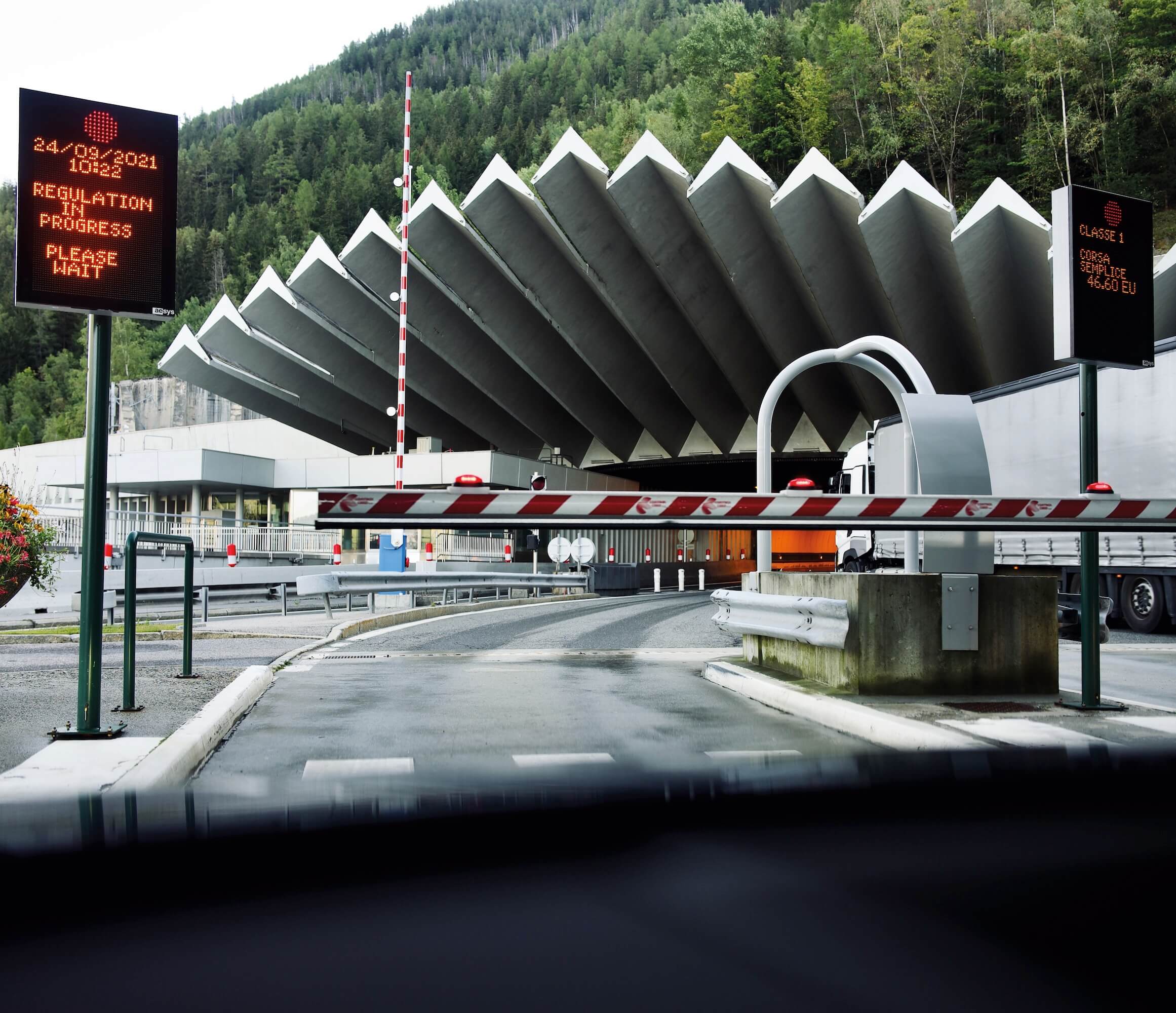
A five-minute drive down the road from the centre of Chamonix, is the road to the Mont Blanc Tunnel. A series of hairpin bends to leads to the tunnel entrance on a steady gradient, for the area and makes for a way to queue lorries at peak travel times.
Joining France with Italy, the 11.6-kilometre tunnel is open 24 hours a day, subject to maintenance (which is usually carried out overnight). One-way, return and multipass tickets are all available from the toll booths at the entrance. On busy days queues build up down the hairpin bends, and in exceptional circumstances they can reach back to the main RN 205 carriageway on the French side. Always check the tunnel website for traffic news before travelling.
In the busiest conditions, lorries are stopped way down at the valley floor, but this doesn’t happen until they are already queueing on the RN 205. Chamonix has a problem with lorries dating back to the opening of the tunnel in 1965. Over the years the valley has become more polluted and air quality has declined, particularly in winter. For many years the gorged entrance to the valley was hung with banners displaying anti-HGV motifs and messages. The French love a good protest, and every year since 1997 the anti-Mont Blanc Tunnel protesters have organised a bike ride from Le Fayet, over the Égratz Viaduct and into Chamonix. The road is shut as a couple of hundred cyclists wend their way up the valley in a friendly and peaceful demonstration.
On 24 March 1999 the valley’s worst nightmare became reality when a lorry carrying flour and margarine caught fire, transforming the tunnel into an inferno. The blaze lasted for the best part of two days while firefighters tried to reach cars and people trapped inside. A total of 39 people were killed. A monument to them can be found on the approach to the tunnel. The tunnel was shut until 2002 while the structure and safety issues were fixed. During those three years pollution levels dropped to normal.
In May 2002 the tunnel reopened to lorries, a development that was met by more than 1,000 protesters and a blockade. Nothing much has changed in the 20 years since, however. Lorries must now go through a scanner to detect any problems, although breakdowns do still happen. Speed limits and distances are strictly enforced, customs and police patrol both sides of the tunnel, and passports are required if not always checked. During 2020, because of the pandemic, the traffic using the tunnel dropped to 1,299,922 vehicles, some 800,000 fewer than in 2019 and roughly the same as when the tunnel had reopened in 2002.
The unassuming approach road to the tunnel is surrounded by amazing scenery, which is easily overlooked when trying to get to Italy. On one side of the road, a trail runs up to Cascade du Dard, a waterfall fed by a series of torrents, with a small cafe nearby. The trail up from Chamonix, the Chemin du Glacier (path to the glacier), is at times very close to the road and can be a bit noisy and polluted if the tunnel is busy. The trail continues up past the tunnel entrance to another cafe, Chalet de Cerro, which is open in the summer and has an unusual selection of aeroplane parts recovered from the Bossons Glacier. A viewpoint of the glacier is a further short walk away, although the ice retreats further from the viewpoint every year thanks to the ever-warming climate in the valley.
At the entrance of the tunnel are the toll booths where after buying a ticket there is an automated pause from the queuing system before you enter the darkened tunnel. About 25 minutes later the lost light returns and the sunshine of Italy appears. The sun rises earlier on this side of the massif, and the weather is often better in the Aosta Valley than in Chamonix. Ahead is a short drive to the town of Courmayeur.
Statistics
| Distance (kilometres) | 11.6 |
| Altitude (metres) | 1274 |
| Minimum Speed (km/h) | 50 |
| Maximum speed (km/h) | 70 |
| 1965 Traffic (vehicles) | 345,072 |
| 2020 Traffic (vehicles) | 1,299,922 |
| 2023 Traffic (vehicles) | 1,677,045 |