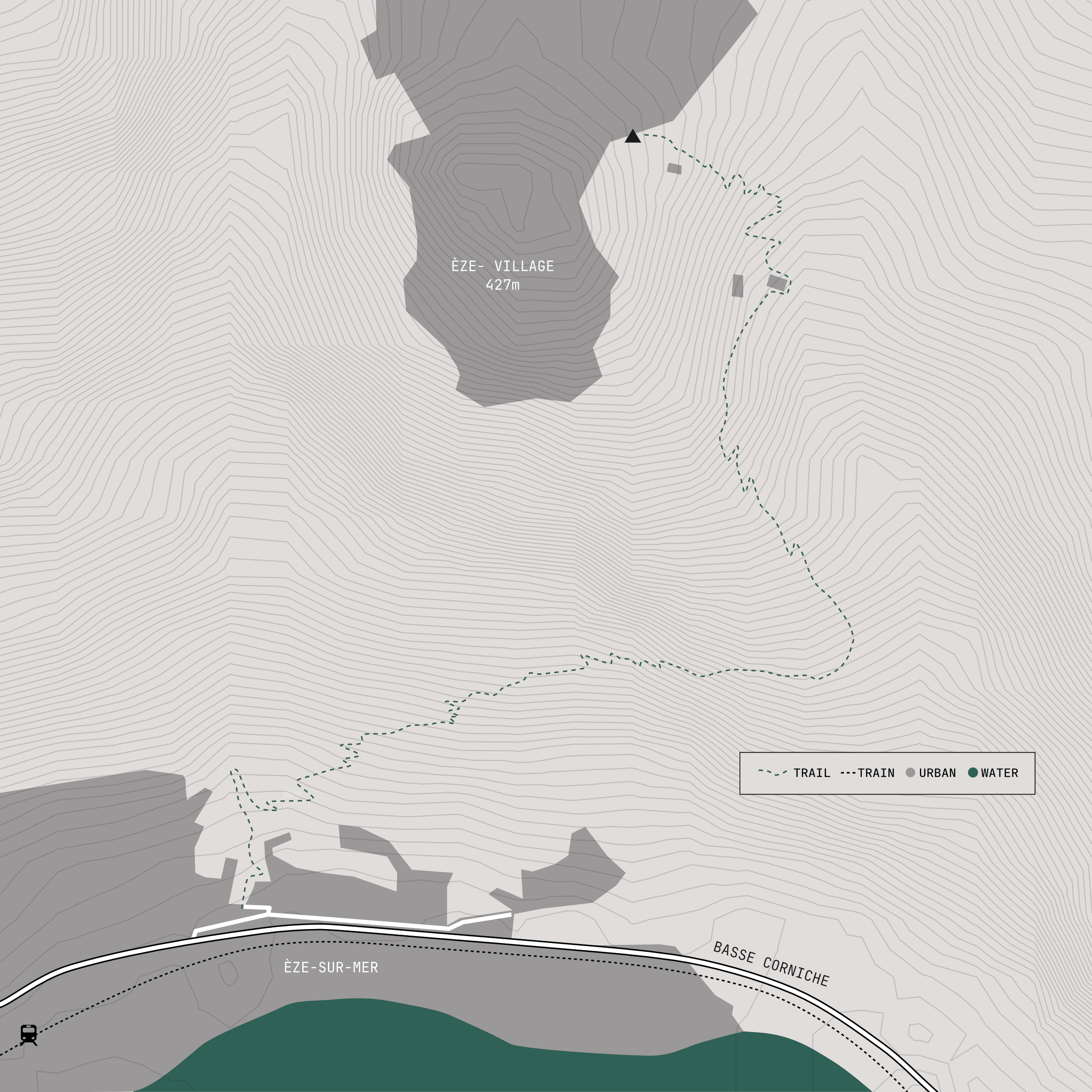
Standing by the sea, trying to find that elusive perfect stone for skipping, the medieval village of Èze looms high above. A short walk to the Basse Corniche, the Riviera’s lowest coastal road, reveals the start of the trail so closely associated with Friedrich Wilhelm Nietzsche that it now bears his name.
Nietzsche stayed in Èze during the winter of 1883–84 and found inspiration here for the third part of Thus Spoke Zarathustra. He later recalled composing its decisive chapter, On Old and New Tables, during the arduous ascent from the station to the remarkable village built into the rocks. The story goes that he walked this steep path between the sea and the village regularly. Not literally writing while walking, presumably, but you get the idea.
The trail that now carries his name is well marked and can be walked in either direction. We are walking up. It is not difficult by Alpine standards, although on a summer’s day it can feel more taxing, if only because of the heat and the steady stream of people coming down. Perhaps Nietzsche’s ideas about overcoming oneself benefited from all this strenuous activity. We came to the conclusion that if everything were to recur infinitely, there would be worse situations in which to find yourself.
The commune of Èze extends from the Mediterranean at Èze-sur-Mer to the medieval village high above. Saint-Laurent-d'Èze lies elsewhere within the commune, although it is around the corner from both and nowhere near the Nietzsche trail.
Some of the trail still feels much as it might have in Nietzsche's day, although both ends have been developed with everything from scruffy houses to luxury villas. Walking up from the sea, the route begins as a concrete path negotiating a walled villa and a rather tired-looking bungalow. It then abruptly turns to rock and dirt, climbing steeply away from the coast. Some sections are carefully maintained, others rather less so.
The views from the lower half are impressive, opening through scrub and trees as the coastline of the Riviera expands below. Around halfway, the trail turns inland and the trees gradually close off the view. The upper section is mostly shaded, with a considerable number of steps built into the hillside, some apparently serving the holiday homes developed in this otherwise unlikely spot. Reading their Airbnb reviews gives a reasonable indication of the number of steps involved, with several visitors discovering that wheeled luggage is not always the cleverest invention.
There is probably an argument for walking from the village down towards the sea, with the view opening ahead before finishing at the beach to sit and contemplate, Nietzsche-style. The village itself, however, is largely hidden from the trail, and the better views of its medieval outcrop are found from the Moyenne Corniche, the Riviera’s middle coastal road.
The Nietzsche trail is around 2 kilometres long and climbs approximately 400 metres between Èze-sur-Mer and the village. Allow around an hour to an hour and a half for the ascent, depending on stops, temperature and the number of people attempting to pass in the opposite direction. Buses serve the upper village and the coast, while the train stops at Èze-sur-Mer. Parking can be difficult in summer, as can the crowds and heat. As with many things on the Riviera, it is probably best experienced out of season, or early or late in the day.