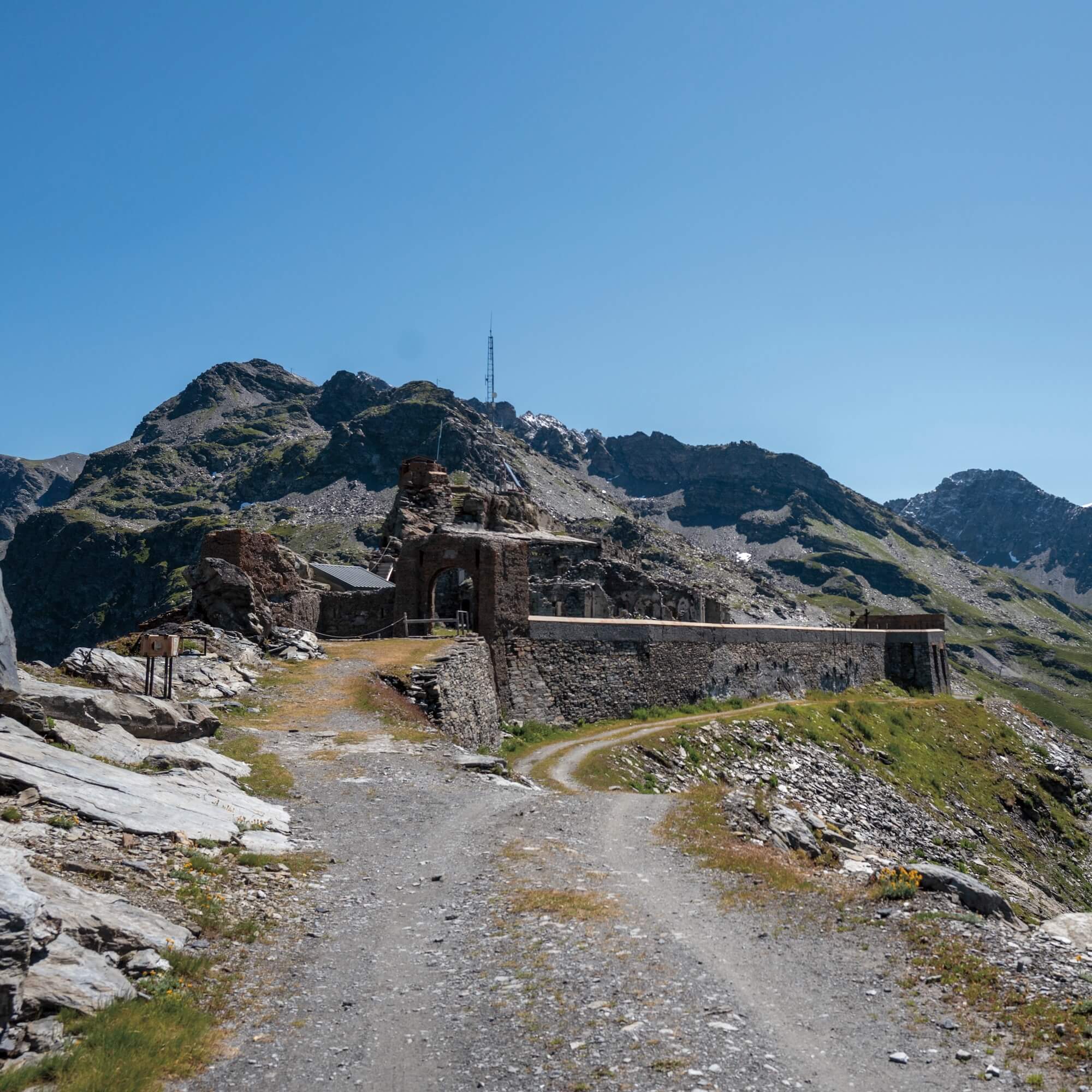
Standing above the Little St Bernard Pass at 2,400 metres, the Fort de la Redoute Ruinée occupies one of the most strategic positions in the western Alps. Perched on a windswept plateau overlooking the border between France and Italy, the ruined stronghold commands views across the Tarentaise Valley towards Mont Blanc. For centuries, armies, traders and travellers crossed the Alps below its walls, making this a key defensive position on one of the principal routes between the two countries.
The original structure was built in 1630 by the Duchy of Savoy using the remains of the earlier Fort de la Traversette. Its location allowed control of the pass and the surrounding approaches, an advantage that would prove valuable during centuries of conflict between the European powers competing for influence across the Alps.
During the French Revolutionary Wars, the Savoyards garrisoned the position with fifty men. French forces captured it in 1794 and renamed it Fort Libre (Fort Free). Following the Treaty of Turin in 1860, which formalised the annexation of Savoy, the territory officially became part of France.
After the First World War, the site was substantially reinforced and incorporated into the Tarentaise sector of the Alpine Line, France's high-altitude extension of the Maginot Line. Concrete fortifications, underground shelters and defensive positions transformed the summit into a modern military stronghold designed to protect one of the most vulnerable crossings on the frontier.
The fort's defining moment came during the Italian invasion of France in June 1940. A small French garrison of just 47 soldiers held the position against repeated Italian attacks aimed at securing the Little St Bernard Pass. Although Italian forces eventually pushed through the pass itself, the defenders continued to hold the summit. By the time the Franco-German armistice came into effect on 25 June 1940, the position remained in French hands. The garrison of the 70th Alpine Fortress Battalion finally withdrew on 2 July, after which Italian troops occupied the site.
Five years later, as Allied forces advanced and Axis control of the Alps collapsed, Italian Alpini and German Gebirgsjäger units abandoned the area. The fighting left the fort heavily damaged, and it has remained in ruins ever since.
Today, battered concrete, collapsed walls and rusting fragments of military infrastructure are scattered across the site. Time, weather and harsh alpine winters have done almost as much damage as the artillery. Yet the setting remains remarkable. On clear days, Mont Blanc dominates the western horizon, while the nearby border crossing allows visitors to walk between France and Italy in a matter of minutes. What was once a heavily defended frontier is now crossed by hikers, cyclists and skiers exploring the high alpine landscape.
The ruins can be visited throughout the year. In summer, a steep one-hour hike leads from the Little St Bernard Pass to the summit. During July and August, lifts from La Rosière reduce the ascent, while longer hiking and mountain biking routes approach from La Thuile on the Italian side. In winter, ski lifts from La Rosière provide direct access to the site, making it one of the few historic Alpine Line fortifications that can be reached on skis.
Few places in the Alps illustrate the shift from contested frontier to shared mountain landscape quite so clearly as the Redoute Ruinée.